LearnTune: Closed-Loop Music Neurofeedback
Student Researcher · Shing-Tung Yau High School Science Award project
I designed and built a closed-loop musical neurofeedback prototype — a custom scalp-EEG headband combined with camera-based sensing — to study whether music that responds to a learner’s state can steady that state during learning.
- Role
- Student Researcher (first author)
- Timeline
- Nov 2025 – Present
- Collaborator
- Ting Jiang, Faculty of Psychology, Beijing Normal University
- Participants
- 29 behavioral · 24 EEG state analysis
- Tools
- Custom PCB · nRF52840 · Python · Machine learning
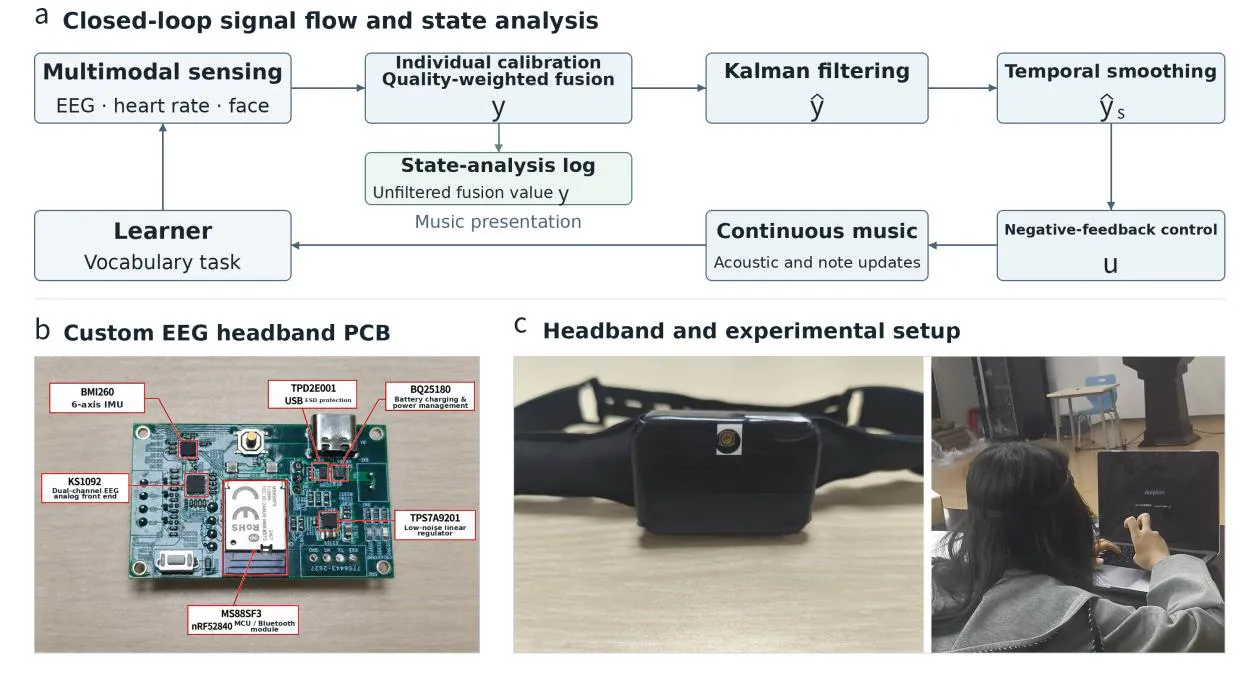
The question
Two learners can have the same average level of arousal but very different moment-to-moment trajectories. Research has linked this variability to attention and memory, but an association is not an intervention. I wanted to test whether music that continuously adjusts to a learner’s own state could reduce that variability — without asking the learner to actively self-regulate.
What I built
- 01
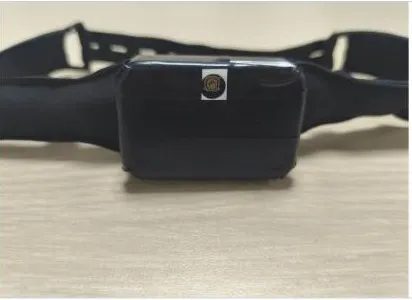
Custom EEG headband
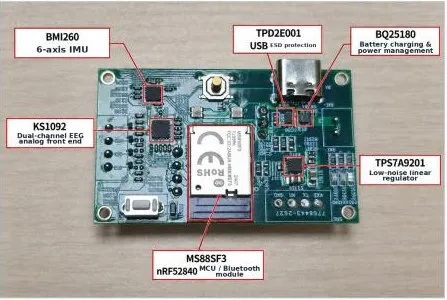
A PCB with a KS1092 dual-channel EEG analog front end, an MS88SF3 (nRF52840) Bluetooth MCU, a BMI260 6-axis IMU, battery management and a low-noise regulator.
- 02
Multimodal sensing
A frontal EEG power ratio, camera-derived heart rate and facial arousal, combined into one composite state index.
- 03
Calibration & fusion
Each learner is calibrated to their own reference centre and scale; inputs are weighted by their real-time signal quality.
- 04
Closed-loop control
Kalman filtering and temporal smoothing feed a negative-feedback controller that continuously adjusts the acoustic and note parameters of the music.
The experiment
A within-participant design compared closed-loop music driven by each participant’s real-time state with music from the same engine using static parameters. Each participant completed four word-learning blocks, two per condition, followed by recognition tests and attention probes.
Of 34 sessions, 30 produced complete records; after data-quality exclusions, 29 participants entered the behavioral analysis and 24 — with sufficient raw EEG — entered the primary state analysis.
What I found
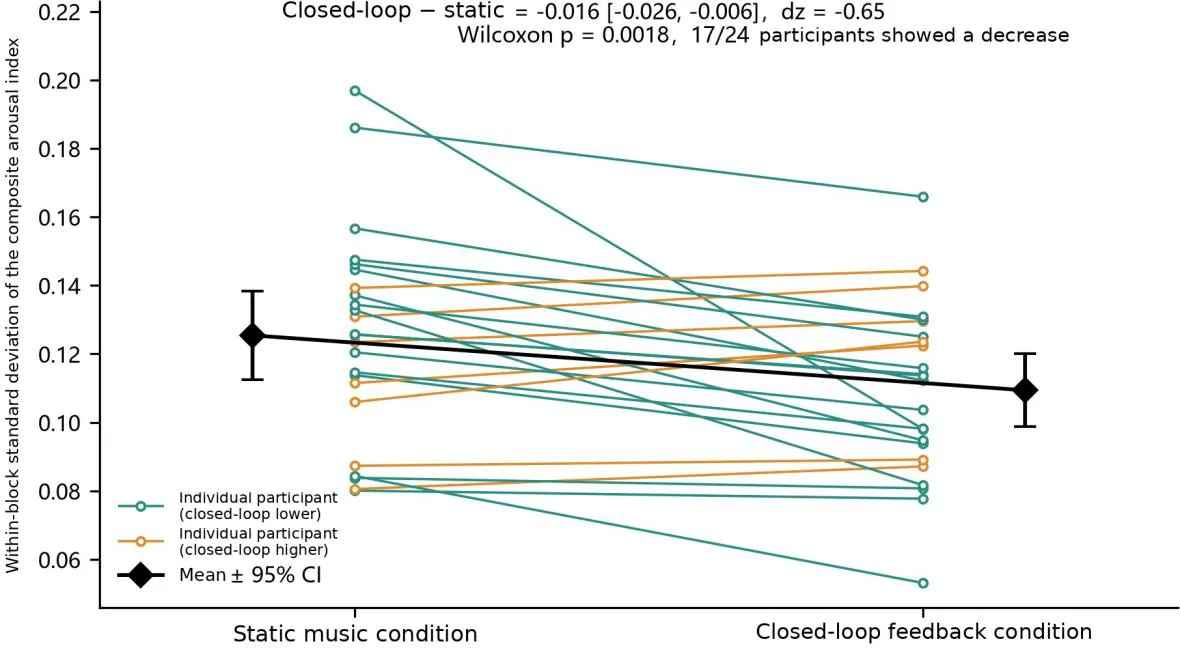
- Over the full feedback period, the standard deviation of the composite index was 12.8% lower under closed-loop feedback (Wilcoxon p = 0.0231; paired t-test after BH correction p = 0.0554).
- No significant difference was found in the mean level; changes in individual channels appeared mainly in facial arousal.
- No improvement was detected in recognition discriminability or reaction time — so the paper presents the system and its measurement limits, not a learning benefit.
Gallery
Video
Experiment sessions
Paper
LearnTune: An Exploratory Pilot Study of Multimodal Closed-Loop Music Biofeedback During Word Learning
Fan, Z., & Jiang, T. Manuscript (LNCS format). Co-authored with Ting Jiang, Faculty of Psychology, Beijing Normal University.
Open PDF →“This was my first time carrying a research idea through the full pipeline. The hardest problem in neuroengineering is often not model accuracy, but the tension between real-world signal noise and experimental control.”